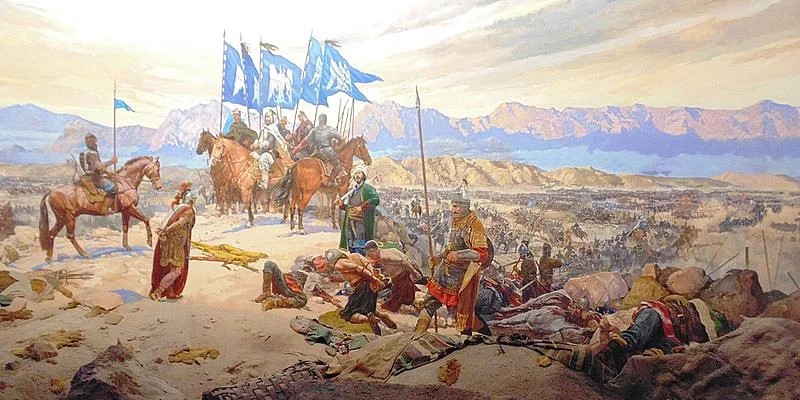
Winning the battle of Manzikert
As many of you who know me, I am a big enjoyer of this game, Europa Universalis 4. With a little shy of 2500 hours of EU4 on the clock, it would be an understatement to say it’s my favourite game. As any paradox interactive fan, I also enjoy embracing the alternatives, the “what if” that could happen (Especially those things that really could have turned out either way), that would result history beyond it to be drastically different.
Now I want to bring to you one of these scenarios, picture yourself going back almost 1000 years, and land in modern day Turkey. You are Umut Çelik, a mercenary employed by the Byzantium Empire himself.
Terms used explained:
- OTL: our timeline (the events happened in the actual history, or at least according to the available written sources)
- Themata/Thema(Greek) - the military-political regions established by Justinian
- Strategos - viceroys of a thema
On a misty morning in the fields of Manzikert…
Umut Çelik woke up to the ground violently shaking. Around him were his comrades in his company, scouring up from their mass tents, gathering at the abrupting shouts from their commanders. An uneasy feeling arose from within him, he knew exactly why the grounds were shaking, it was as if it was carved into his genetics – thousands of war horses charging into a fight.
Umut knew the day that his company marched eastward that he was going to be faced against his blood-related kin, but he didn’t know this day would come so soon, so suddenly, so.. violently.
Arrow rained into the camp before Umut could even contemplate further, and as he reached for his mail, his right hand was torn away from him. A great, piercing pain followed, as Umut found an arrow through his right palm, pinning it to the ground. The adrenaline followed pulled the arrow out for him, as he returned to his mail and grabbed his saber, and followed his company out the camp grounds.
Thousands of horses as he imagined confronted his company, along with the varangians and the empire’s theme troops, in total 20 thousand strong. Umut’s side out numbers the army across them, as they are same in width but far sparse in formation.
Umut looks closely at the enemy: The ones on the wings are close, while the centre ones with Alp Arlsan’s flag sit farther away. This is the crescent formation, Umut thought to himself, as a charging horn blew behind him. Rushing, Umut unsheaths his saber, waving it towards horse archers pulling away.
This the parthian tactic, the age-old tactic, as Umut thought to himself as the gap between the armies only grew farther apart. But before most of his comrades could make the same observation, another army in purple appeared over the hills behind the enemy.
It has to be Tarchaniotes’ army, another 20 thousand strong, even without seeing the banners, Umut knew that this battle was going to conclude soon – his kins has ran out of space to retreat.
This is what COULD possibly happen at the Battle of Manzikert, and it is a section of alternative history that I have been stretching further down in the river of history.
So the direct result of the Empire’s victory in this battle would result in the turkic incursion in Anatolia to stop, as Alp Arslan (if still hasn’t died yet, all things considered he was assassinated a year later in OTL anyways) loses his authority and muslim allies through his resounding defeat. The remaining turkic population, without a regime to protect them and religious fluidity, would likely convert to the Orthodox and bow to the Ecumenical Patriarch in Constantinople, assimilated into the Empire like the various “south-slavs” in the Balkans. Umut the mercenary, is more than likely to be one of them, and take up a more permanent position in the Empire’s militia.
Albeit Byzantium’s victory, it still had such a long list of issues, which the most significant are: Eroding theme systems, political instability and autonomy, debased coinage and growing inflation, but as the major exterior threat in the east defeated, the Empire can focus back on to these issues. Though alexios komnenos won’t therefore have the chance to usurp the throne through the Empire’s chaos in OTL, Romanos and the Diogenes family managed to centralise power through the support of these newly gained citizens of the Empire (the converted turks), as they deem Romanos as a powerful figure through victory at Manzikert. The support of these new citizens could come through violence, or simply politics in Constantinople, but nevertheless Romanos has tilted the balance of power within the Empire, enabling him to disarm the Ducas family, reform the thema, by removing strategos that are becoming like feudal lords and replacing them by general-aristocrats from the capital.
I recognize what Romanos was able to do in the past paragraph is possibly more implausible than the victory at Manzikert itself, but rather than praising Romano and his ability that he never showed in OTL, I am hypothesizing a more stable Empire in the few decades following the battle. (So yes I am considering a rather large group of alternative timelines rather than just Romanos wins at Manzikert. But why Romanos? why Manzikert? Simply that it is among one of the most plausible alternatives that would bring this inner stability). Continue reading to see why this stability or even thrive of the Empire is significant.
Now with a strong Byzantium influence maintained in east Anatolia and north Levant and zero to none nomadic forces, the first crusader would be even more successful than it was in its history. This is not to say that all Seljuk forces would not exist, but large, independent nomadic forces would be hard to continue to thrive in this area which they can not control.
The Crusade even more success could be attributed to the weaker muslim armies, unable to fight as an organized army, the muslim conscripts through secular power or Jihadist through religious authority would lose badly to the crusaders. (Just like the sixth crusade but the way around).
The successful Crusade attracted a great inflow of European Christians, much greater than it was in history, as the Levant is pictured as a land of riches, of opportunity, of religious pilgrimage and duty. Some might have even called it at the time: “The Levantine Dream.”
The further implications of this alternative timeline goes far beyond, but now I am returning to do some more reading to see what Christian influence further east into the old world would stir up the timeline.